
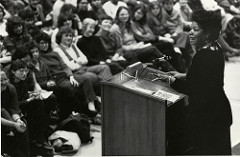
Photo credit: Burns Library, Boston College via Foter.com / CC BY-NC-ND
This was my first time reading this book. I had heard of it and Maya Angelou, but was never made to read this particular classic. The kindle book went on sale a year or two ago and I bought it, knowing I should read it, if only to know what people were talking about when they referenced this book. But, like so many other ebooks I’ve bought on sale, it sat on my kindle, unread until Book Riot challenged me to read a classic by a person of color, and that was my excuse to finally read this book.
It’s wonderful.
I’m sure that goes without saying, but let me say it anyway – at least why I thought it was wonderful.
I think what struck me the most was how beautiful the prose is in this book. In addition to writing several autobiographies, plays, and movies, Angelou was a well-known poet and that comes through in her writing here. So many passages sounded like poetry that I would find myself reading them over and over again, just to be able to more thoroughly enjoy them.
It’s also an extremely thoughtful book. It focuses on her childhood (ending when she’s just a teenager, shortly after the birth of her son). Of course she’s writing as an adult, but her awareness of her motivations as a child, as well as the motivations of those around her (even if she wasn’t thinking of them at the time) were extremely profound and impressive. Nothing like an adult talking about the mistakes they made and basically saying, “What can you do? I didn’t know any better” (except stated much more beautifully than that).
I don’t know if this book’s intention was to focus on racism or if it was just so much a part of Angelou’s life when she was growing up that she couldn’t not talk about it. She moved around a lot as a child, but considered Winston-Salem, North Carolina to be her home. That’s where she lived most of her childhood with her brother, paternal grandmother, and uncle. Her grandmother was the only black person in town to own a store, so Angelou and her brother were lucky in that they never went hungry or homeless, but they saw the misery of the sharecroppers who came through the store every day, working their butts off with little-to-no compensation.
Then there’s what Angelou called the powhitetrash. White people with no money, no manners, and apparently no hygiene, but in the stupid hierarchy of the segregated south, they sat just above black people – even the smart, educated, business owners – and they made sure to take full advantage of that fact. They taunted Angelou’s grandmother, trying (and failing) to get a rise out of her, and made a mess of her store. It drove Angelou to distraction, but her grandmother just accepted it all with the resignation of a black woman born in the 19th century south who knows the world won’t give her anything, no matter how hard she works. Angelou’s remark about the surprise people express regarding the strength of black women also mirrored my thoughts exactly. How would you expect them to turn out after you’ve put them through all that?
I especially loved Angelou’s description of everyone she knew crowding around the radio to listen to the championship match between a black man and a white man. That was not just a game for them. It was nothing less than their one and only chance to prove that blacks were at least as good as, if not better than, whites. If their guy lost this match, there was no telling how long it would be before (or if) they would get another opportunity to prove themselves. It’s just another example of when losing was simply not an option for black people in America, and it reminded me of how seriously black baseball players took Robinson’s acceptance into the major leagues.
I also loved Angelou’s story of how she became the first trolley conductor in San Francisco because the way in which she told it was so matter of fact. There was nothing grand or majestic about what she did. She didn’t do it to be a trailblazer, she just wanted that job and refused to take no for an answer. She doesn’t even remember what was different about the day they finally hired her. My guess is she probably just wore them down until they gave up. I’m sure it was tedious and exhausting, but sometimes that’s what it takes to get what you want.
What did you guys read this week? Any other classics that were new to you?