
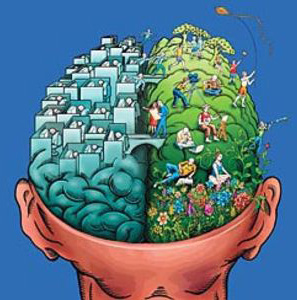
Photo credit: kire via Foter.com / CC BY-NC-SA
My dad and youngest brother both read this book before I did, and when I asked my dad about it, he made a joke about not liking it because it was telling him how stupid he was. I knew it was a joke, but it still made me kind of hesitant to read it. That and I was anticipating it would be a dense slog and take me forever to finish.
But I kept seeing it on everyone’s “best” and “must read” lists, and then Book Riot challenged me to read a nonfiction book about science (I finished this book in early November last year, I just have a huge backlog of book reviews right now) and that pretty much finished off my excuses for not reading this book. As it was I still put it off until I had met every other requirement for the challenge.
This book is not nearly as scary as my dad made it out to be. I don’t know if it’s because I majored in psychology or if I’m just unusually self aware (or both), but I was already well aware that their are flaws in the way we all think (myself included). I did not find this book scary or depressing or anything negative. I though it was informative and extremely well written, and at times even funny. Like a true psychologist, Daniel Kahneman is well aware that he is no exception to the rules in thinking and behavior that he and his partners have found. He is more than willing to laugh at his mistakes because he realizes they make him human.
Kahneman describes two parts of the brain: System 1 and System 2. System 1 is the part that thinks quickly (and often on an emotional level), while System 2 does the more “rational” and “logical” thinking. When we think of ourselves (our personalities, our tastes, our ability to reason, etc.) it’s usually our System 2 that we’re thinking about. Because it takes more work, System 2 is much slower than System 1 (which is nearly instantaneous), but System 2 is also lazy and often heavily influenced by System 1.
Kahneman was careful to point out that the names “System 1” and “System 2” are used merely for simplification purposes. There is no region of our brain dedicated to one or the other (that we know of yet) and they’re certainly not two separate personalities living inside our heads. Rather it’s a way of conveying, in a manner that can be easily understood, how we think and where so many of our mistakes in logic come from.
Like I said, I majored in psychology, but you absolutely do not need any kind of background in psychology in order to understand this book. Kahneman was not writing this book for his colleagues, but for the average reader, and I think he did an excellent job making the material accessible without talking down to the reader.
After all these years of procrastination, I’m glad I finally got around to reading this book. It was smart, funny, informative, and highly engaging. I’m afraid I now have to add myself to the list of people who have put this book on their list of “must reads.”
What did you guys read this week? Anything else you’d been putting off for a while?