
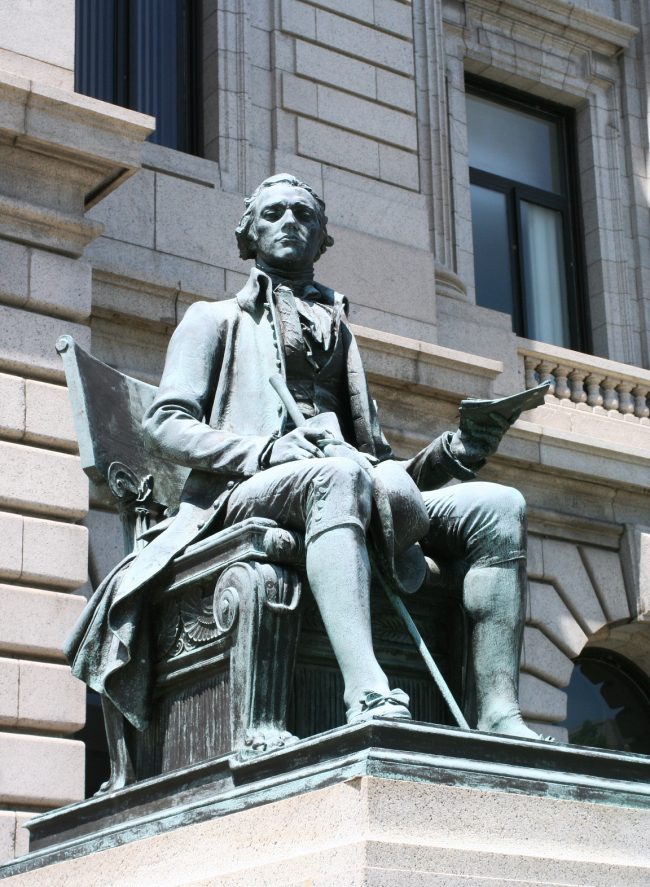
Photo credit: OZinOH via Foter.com / CC BY-NC
I have yet to see Hamilton or listen to the soundtrack (I know). At first I thought I wanted to see it before I listen to the soundtrack, but A) it’s only getting harder to get tickets, and B) I’ve been known to listen to soundtracks before seeing the show and it hasn’t ruined anything. Besides, it’s getting increasingly difficult to exist in the world without hearing at least snatches of songs from the musical (and it does sound awesome!)
I’m determined to find a way to get tickets when the show comes to Chicago and I wanted to be ready by having read the book that inspired it. Also it fulfilled three of the requirements for the Book Riot Read Harder Challenge.
Nothing makes me feel like a slacker like reading this book (which is a mere 730 pages before all the notes, references, etc.). Hamilton was just nonstop and his life was full of excitement and intrigue, starting from before he was born and his mother ran away from an abusive marriage to be with James Hamilton, a younger son of a minor Scottish lord who was constantly impoverished because he couldn’t succeed at anything he tried.
Hamilton was born in the British West Indies and got a lucky break to go to college in New England, which is where he ended up right before the Revolutionary War broke out, at which point he quickly joined the military. This meant he was up at dawn to do drills, went to classes and studied during the day, and then stayed up late writing pamphlets and opinion letters that were published in the local newspapers, only to get up the next day to do it all over again. Whew!
That kind of hard work was certainly a key to his success, but it was only one part. He was also fortunate enough to be born a genius with incredible intellect, and, of course, he made the right connections. He wasn’t always right, but he was usually right and he was lucky enough to work alongside people who recognized his talents and promoted him accordingly. Of course, it didn’t hurt that he was a white dude working in a white dude’s world, but still. The man had serious skills.
I learned so much about politics by reading this book. I had learned the basics in school: George Washington was general of the colonial army and our first president, we won the Revolutionary War mainly through guerrilla tactics, the Articles of Confederation didn’t work, which is why we formed the Constitution. Also that slavery was a compromise that had to be made to get enough states on board with the Constitution, despite the declaration that “all men are created equal.” What I found interesting was the fact that people were predicting the civil war from the very beginning.
The one part I’m unsure of is the Constitutional Convention. Chernow’s account reinforces what I learned in school, which is that our founding fathers based our government on what they knew of Greek democracy and a modified form of the British government at the time. But Gloria Steinem had a very different version of where the inspiration for our system of government came from. I trust Chernow knows his stuff, but I just don’t know whom to believe here. I guess Rushdie was right when he talked about how everyone has their own version of history.
There were just a couple places that dragged for me. The first was the section that described Hamilton writing the Federalist papers. Despite the fact I mostly appreciated how much I learned about politics from this book, that part delved a little too deep and was a little too technical for me to really enjoy reading it. Also it continued to make me feel like a slacker because Hamilton wrote most of the Federalist papers himself, in a very short time frame, while running his own business and starting a family. The part I did find fascinating was that the Supreme Court continues to cite Hamilton in its rulings more than 200 years later.
The end was also considerably longer than I think it really needed to be. Chernow spends about 50 pages describing the events leading up to and surrounding Hamilton’s death, as well as the effects afterwards on his family, not to mention the political landscape. Its the most number of pages spent on the shortest time period in the whole book and I wonder if it was entirely necessary.
That said, the book is still very well written. I found myself rooting for Hamilton and hoping he would make it out alive, despite already knowing the outcome. Chernow is that good a writer.
What did you guys read this week? Anything that taught you something about your own history?