
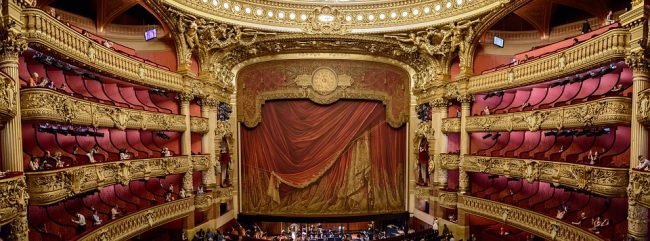
“All right, everyone, they’ll be opening the doors soon and we’re going to be ready for them. You all know your positions and responsibilities. I hope I don’t have to remind any of you that there will be no repeats of last night’s … incident. If I catch so much as a whiff of impropriety, you won’t like the consequences. I’m looking at you, Phyllis.”
“Why do you always have to single me out?”
“Oh, I’m sorry.” Dean’s voice was all sarcasm. “Did you have someone more deserving in mind? Harvey, perhaps?”
Everyone snickered. Even Harvey couldn’t suppress a small smile of satisfaction.
In the four decades he had been working here, he had never even been reprimanded. His employee reviews were always impeccable, and he worked hard to make sure they stayed that way.
Harvey had initially taken the job at the opera house to help make ends meet after moving here with his family from Memphis. He had gotten the gig after a friend recommended him, and although Harvey had come dressed in his best, the interviewer had still looked down his nose at Harvey (quite the accomplishment, considering Harvey stood a head taller). But Harvey managed to convince her he would be a hard worker who always showed up on time and wouldn’t make any trouble. That, combined with the recommendation, was enough to get Harvey the job.
But it had become so much more than a job to Harvey. From the moment he had first put on his uniform, he had felt like a different man. He stood taller. He spoke differently, although initially that had just confused everybody. He realized he had been trying to do a kind of a British accent and failing miserably. He gave that up, but he didn’t go back to the way he had been accustomed to speaking – at least not all the way.
He paid attention to the way the patrons of the opera house spoke. Many of them spoke more loudly and more slowly when they were talking to him, as if he were deaf, but he didn’t mind. He listened to their conversations while trying to make it seem like he wasn’t eavesdropping. He invested in a dictionary (a considerable splurge, but he thought it was worth it), made a list of new words he heard and looked them up when he got home after the show.
His language improved, and after a few years, they stopped talking to him like an imbecile. It helped that he usually pre-empted them by talking to them first and talking fast. He had noticed that people always seemed impressed by those who spoke quickly, and it had the added benefit of making the whole process go more quickly so he could move on to helping the next group of patrons find their seats.
They were impressed with his demeanor and speech – when they noticed him at all. He had to admit to being disappointed when someone he worked so hard to please barely acknowledged him, but he reminded himself it was part of the job. He was supposed to lead patrons to their seats and then just blend into the background while they enjoyed the show.
And that’s exactly what he did.