
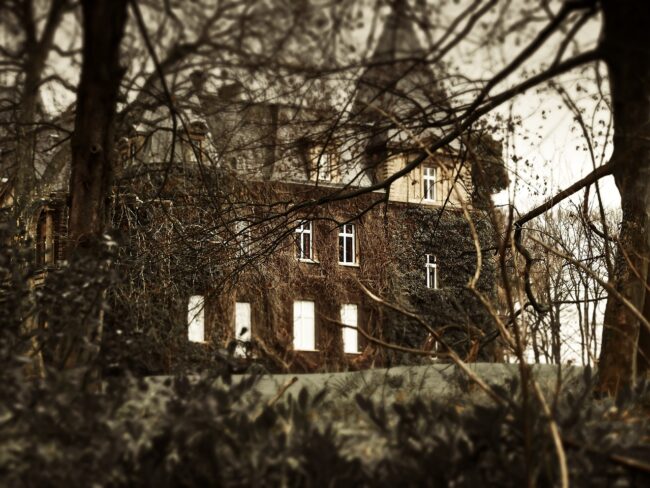
I’ve been putting off watching Michael Flanagan’s adaptation of this book because I wanted to read the book first, but before reading it, I wanted to finish the collection of short stories by Shirley Jackson I started reading years ago.
I finally finished the short story collection at the end of last year, so I lost no time in getting this audiobook from my library and listening to it while making Christmas cookies.
It’s told in third person limited from the perspective of Eleanor, a woman in her early thirties whose mother recently died. Eleanor was her mother’s caretaker, and because of the demands of that role, she has had no opportunity to build a life of her own. She has no job, no friends, and no family outside of her sister, who doesn’t seem to care about Eleanor’s wants or needs.
When Eleanor is invited to spend the summer at a supposedly haunted house to prove that paranormal phenomena is real, she asks to borrow her sister’s car so she can go.
Her sister declines because she or her husband “might” need it. So Eleanor steals the car and makes her way to Hill House anyway.
The house is definitely weird. It’s built in concentric circles so there are some rooms without any windows. Sometimes someone will be trying to find a room and the doors to that room will swing shut all on their own. At one point, Dr. Montague, the professor who brought them all to Hill House, tells Eleanor they knew she was looking for them when the doors swung shut on their own.
The house also comes with a couple caretakers who are adamant about when meals are served and the fact that they absolutely will not stay at or come to the house after dark.
Eleanor’s grasp on reality seems tenuous even before she gets to the haunted house. She overhears a family at a diner talking about their young daughter’s cup with stars painted on the bottom. When she gets to Hill House, she tells someone about the cup as though it were her own.
Eleanor is desperate for human connection. She tries to make friends with Theodora, the only other woman of the group, and Theodora seems willing at first, but is soon put off by how clingy Eleanor is. She really pulls away when Eleanor starts talking about the two of them moving in together after they leave Hill House.
But rather than tell Eleanor she’s not interested, she’ll do things like go on a walk with Eleanor, but let Eleanor walk ahead and sit down to enjoy time without her. When Eleanor finds her, she tries to gaslight Eleanor by telling her they had called after her to tell her they were taking a break and Eleanor just hadn’t heard them.
It’s not exactly helpful for Eleanor’s grasp on reality. Neither is being in a haunted house.
Eventually, the house starts calling to Eleanor. At one point she ends up walking on a precarious part of the house. Everyone else calls for her to come down, but she doesn’t seem to be entirely in control of her actions and the others fail to realize that.
Instead, they decide it’s time for her to go home. I won’t spoil the ending for you, but it’s so good!
I like that the focus of the story seems to be the house itself rather than the ghost of a past inhabitant.
I happened to read this book right after watching Stephen King’s Rose Red without any idea that King based his miniseries off this novella. But since I happened to read this book so soon after watching the miniseries I was able to see all the parallels.
I thoroughly enjoyed both the book and the miniseries, and I recommend them both if you like a good haunted house story.