
This doorstop by Donna Tartt has been taking up several cubic inches of space on my bookshelf for at least four (maybe five?) years now. When I heard the movie was coming out, it was an excuse to finally read that behemoth and get it off my shelves.
Too bad it took me so long to read that the movie is no longer playing at my local movie theater. Also, I’ve heard the movie is only OK, but not as good as the book, and since I didn’t really like the book, that’s not much of an incentive for me to go see the movie.
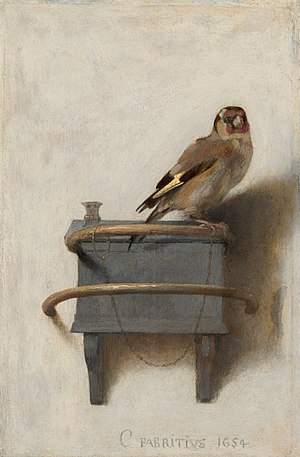
The book gets its title from a small, 17th-century Dutch painting about a goldfinch that is chained to its perch by a thin, gold chain. Apparently it’s a real painting and the history Tartt talks about in the book, how it was only one of a few of Fabritius’s works to survive the gunpowder explosion that killed him and destroyed most of his works, is true.
It’s unclear when the book takes place. It’s one of those that starts at the end, goes back to the beginning, and works its way through chronologically. At the chronological end of the story, it’s Christmas and the narrator, Theodore Decker, is trapped in a hotel room trying to get out of Amsterdam and back to the U.S., but he lost his passport and can’t get a new one because the U.S. embassy will be closed for Christmas on Friday, the 25th, then the weekend, so they won’t be open again until Monday, the 28th.
Both 2009 and 2015 had Christmas on a Friday. On Christmas day, Theo’s friend, Boris shows up and in the midst of his incessant chatter, he makes a comment about “that guy who landed the plane on the river a few years back,” referring to Sully making an emergency landing on the Hudson, but that happened in January of 2009. So Boris is either confused about time (entirely possible), or Tartt is. I suppose it’s possible for her to set the book a couple years after she published it in 2013, but 2009 makes the most sense. Except, then she has Theo say his mother died 14 years ago, which would put the beginning of the story in 1995, but just a year or two after that, Theo is listening to music on an iPod, which wasn’t invented until 2001. Maybe Tartt did set it in 2015. Or maybe she has no idea what she’s talking about. They both seem equally likely.
In any case, after Theo tells us his mother has been dead for 14 years, he goes back to tell us about the day she died, how they were on their way to talk to a school administrator because he had gotten suspended, but they had some time to kill, and since his mother was an art lover, they decided to stop by the Metropolitan Museum of Art and look at some paintings. They’re in the gift shop when his mom says she wants to go back for one last look at the painting. Shortly after she leaves, there’s an explosion, and the next thing Theo knows, he’s on his back, covered in dust and debris.
He tries to find his mom, but is unsuccessful. Instead, he stumbles across a man who is dying from his injuries and is hallucinating. He gives Theo the ring off his finger and tells him to find Hobart and Blackwell, and to “ring the green bell.” Before he dies, he seems to be telling Theo to take something out of the museum to keep it safe. Theo grabs what he thinks the man is pointing to, but it’s been knocked off the wall and turned around so that it isn’t immediately clear that Theo has just grabbed Fabritius’s famous painting and stuffed it in his bag. In fact, it took me a while to even realize that was what had happened. Later, when he has the painting, I was like, “Wait, where did that come from?” I had to go back to find out how he had ended up with it, so it’s a good thing I didn’t listen to this one on audio.
Theo manages to get up and wander around the museum and find his own way out. He tries to warn the emergency crew that there are still people in there that need help, but they’ve found another bomb and the bomb squad is busy trying to deactivate it, so all the cops care about is getting Theo away from the building before it explodes.
Theo makes his way back home and decides to wait for his mom there and Tartt goes on and on and on about how long he waited and all the things that went through his head while he waited for his dead mother to come home. That could have been really effective, except Theo had already told us that his mother had died that day, so there was no suspense. Instead it just felt like I had to read pages and pages and pages of absolutely nothing happening. There are times when starting your story at the end and working your way chronologically back to that point can draw the reader in, but in this case, it just bored me. It took away all the suspense from the dozens of pages Theo spent wondering where his mom was and when she would get home.
Theo’s alcoholic father had abandoned them a while back, so he’s living alone in this apartment for a few days until some social workers show up and break the news that his mother is dead. But, of course, the reader already knows this, so can we please just move on already?
The question of what to do with Theo is a bit of a problem because they don’t know where his dad went, his mother’s parents are long dead, and his father’s parents have no interest in taking him in. So, when the social workers ask him where he can stay, he impulsively gives the address of his friend Andy Barbour, even though they haven’t been very good friends for the past few years. They both got into a prestigious school and Andy has been working his butt off to earn good grades and learn everything he can, while Theo has fallen in with the wrong crowd who got him suspended from school and then stop talking to him after his mother dies.
Fortunately, the Barbours are more than happy to take Theo in. Mr. Barbour is a very wealthy man who made his fortune on Wall Street and Mrs. Barbour is a professional socialite. Andy’s older brother, Platt, is a sociopathic bully and troublemaker who’s been shipped off to boarding school, and Andy’s younger sister, whom they call Kitsey, is terrified of Theo because Platt told her that Theo was there to steal all her stuff.
So they stay out of Theo’s way and Mrs. Barbour does her best to take care of Theo, including keeping reporters away from him and keeping newspapers with disturbing reports of the explosion out of his sight. After a few days, Theo goes back to school and starts to form a sort of routine, and then he decides to check out Hobart and Blackwell, which is just a bus ride away from where the Barbours live on Park Avenue.
It turns out that the dying man who gave Theo his ring lived and worked at Hobart and Blackwell (he was the Blackwell part of the business). Hobart answers the door, Theo explains why he’s there, they bond over their mutual loss, and Hobart lets Theo visit with Pippa, the red-haired girl Theo had seen at the museum before the crash. She took a nasty blow to the head, so she’s still not quite herself, but she enjoys talking to Theo and he enjoys talking to her.
Theo makes more visits to H&B, and one the second or third visit, Hobart invites him down into his workshop. It turns out that Hobart and Blackwell is an antique store and Hobart specializes in restoring antique furniture. He shows Theo everything he knows and Theo loves it.
But if that were all there was to it, this book would be a reasonable length instead of the doorstop it is. So Theo’s alcoholic father (now sober) appears out of nowhere with his girlfriend, Xandr,a to whisk Theo and anything valuable from the apartment back to where they’ve been living in the suburbs of Las Vegas. Theo is desperate to keep the painting a secret from them, knowing it would disappear into the wrong hands if his father or Xandra ever found out how much the painting was worth.
I was about to give up on this book because, at this point, I was 200 pages in and the explosion was the only thing that had happened. A competent storyteller could have told the entire plot in that many pages. But I was too stubborn to give up, so I kept reading and I was glad I did because then Boris showed up. Boris’s mother is also dead and his father is also an abusive alcoholic, so he and Theo have a lot in common right off the bat. The difference is Boris is actually interesting.
There’s no denying that Tartt’s writing is beautiful, but I think she’s a little too in love with her own prose and would do well to just stick to the plot instead of going on and on and on about how it feels to get high (there are a lot of drugs in this book) or how pointless life is, or how beautiful artwork is. This book could have been half the length and I think the story would have been better served, but I might be in the minority in that opinion. I know a lot of people out there love Tartt’s writing and could (and did) read it all day long.
What did you read this week? Any other bestselling award winners that did nothing for you?