
10 Things Nobody Told You About Being Creative
I picked up this book by Austin Kleon from the library because I read another book by him: Show Your Work!. I thought that book was very thought provoking, and as I was browsing its reviews on Goodreads, I didn’t see a single review under 4 stars. They were all 4- and 5-star reviews and a lot of the reviewers mentioned Steal Like An Artist as being as good as, or better than Show Your Work! Given what a quick read Show Your Work! was, I decided I had nothing to lose by picking up this book except a couple hours of my life.
I think they were a couple hours very well spent. Like Kleon’s other book, this one is packed with ideas on how to be creative. He also touches on how to show your work and get discovered, but of course he covers that in much more depth in Show Your Work!
Your Idea Is Not a Special Snowflake
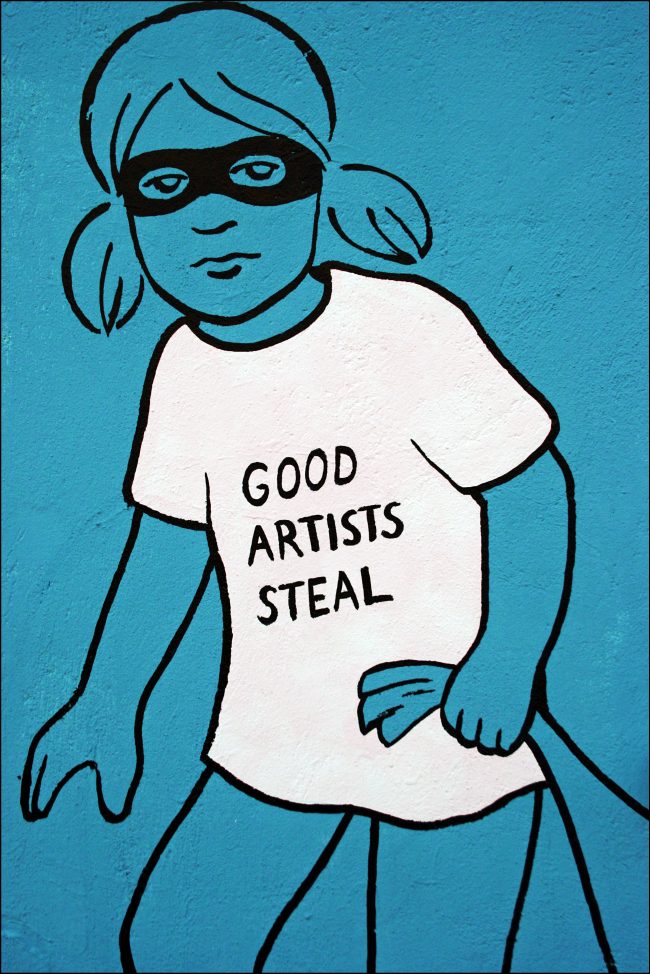
The basic premise of Steal Like An Artist is that nothing is original. Every story has already been told. Every song has already been sung. Everything has already been drawn. So where does that leave us?
According to Kleon, it leaves us with a whole lot of source material. We may not have any original ideas, but the way we present them is all our own. We can “steal” ideas from our favorite artists and use them to create our own work. It’s not the same as copying (at least it shouldn’t be), because we can’t help but put our own spin on it.
You Are What You Study
So Kleon suggests finding your favorite artists and studying everything we can about them. Study their work. Study their life so you can figure out how they think in order to create the art they create. Then go create your own. The beauty of this is you’re never limited to one artist to study. Pick several people you admire and study all their works. Study all the great artists you can. That way you’re not copying anyone’s work: you’re combining all these different influences to create something that is entirely your own.

Work Your Butt Off
Kleon also has a number of tips for boosting your creativity. I like his idea for an analog desk and a digital desk, but I don’t think that would work for me. His theory is the computer is for editing, whereas the rough draft should be done the old fashioned way, with paper and pen/pencil. I disagree, because when I write on my computer, I don’t worry about editing because I know it’s super easy. I don’t nitpick over word choices or where I put a particular paragraph, because I know I can change all that in the blink of an eye. When I try to write by hand, it takes me much longer and I’m more likely to agonize over the details.
That’s just me though. As a cartoonist, Kleon has clearly found something that works for him and that’s awesome. I might still give his advice a try, and I’ll definitely try some of his other tips, including keeping a logbook (I’ve already started journaling once a week), and a wall calendar where you can cross off each day you accomplished your task for the day.
Inspiration Is Everywhere
This book really resonated with me, because I’ve always felt like I always get my best ideas from watching TV or reading a book. Even a stupid commercial can make me wonder about something, which can lead to an idea for a story. Why is this commercial so stupid? Why did they think this would make people want to buy their stuff? Does it make people want to buy their stuff? If so, why? If not, why not?
The key is to never stop asking questions, no matter what, and Kleon emphasizes that, too. One of his main pieces of advice is to stay curious. I happen to think that’s a great idea, not just for the artist, but for all of us who want to live a meaningful life.