
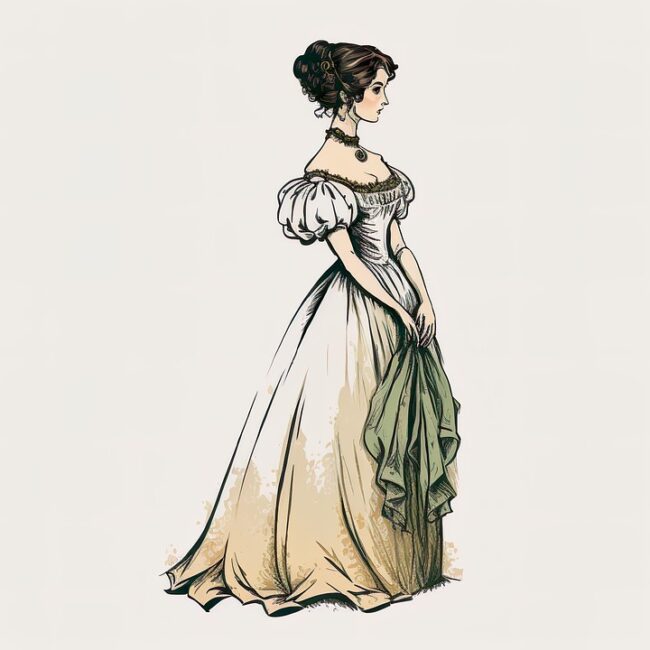
Any time I watched a Regency or Victorian movie with my mom and the women were not constantly wearing bonnets when outside, my mom would complain about the lack of historical accuracy.
Although I’m not a filmmaker, I could see why a director would make that choice. Not only does Hollywood prefer long, flowing locks, but a key part of a bonnet’s job is to cover a woman’s face to protect her complexion from the sun. It’s hard to get a good shot of your leading lady if her face is always hidden.
My mom didn’t just enjoy historical dramas, she enjoyed history, and I inherited that love from her.
I’ve read my share of both fictional and nonfiction accounts of various historical figures, and so did my mom, so I wasn’t surprised to find this nonfiction book by Lesley and Roy Adkins in her book collection after she died.
It’s delightful.
It draws on a lot of first-hand accounts from the time, mostly letters and personal journals.
Some of those letters were Jane Austen’s own, but mostly they relied on a few other people of the time period, including a maid and a pastor.
Since the goal of the book was to portray life in Regency England, the authors decided to start with birth and childhood, then marriage and work, and end with illness and death. I can’t think of a better way to organize a book about life in Regency England than to take it from beginning to end.
As a lover of history, there was a fair amount covered in this book that I had already known, but I also learned a lot. For example, I had no idea how long it took for the English government to control minting their own coins. Up until the early 1800s, various businesses all over England were minting their own coins and they were accepted as legal tender, although sometimes they were only accepted in certain small geographical areas.
As someone who loves to travel, I hadn’t considered how rare travel was for most people at the time, although it makes sense given how expensive and time-consuming travel was. A person was considered to be well traveled if they got to visit different parts of England, as Austen did, although in her case it was largely by necessity after they got kicked out of her childhood home.
I also found the chapter on work fascinating. I had known that most employment options of the time were extremely labor intensive and low paying, but this book offers a closer look at some of the most common jobs, including coal miner — one of the most dangerous, but also one of the better-paying jobs for an unskilled laborer. It gives me greater appreciation for how lucky Austen was to make a career for herself when there were so few professions available, and even fewer available to well-educated women.
I also appreciated the chapter on crime, because who doesn’t love a look at the seedier side of society? Although crimes don’t change much over the years, punishments do, and I was shocked at how brutal some of England’s punishments were, especially for crimes most of us would not consider to be that serious. Many crimes were either explicitly punishable by death, or resulted in death as an accident of the punishment.
The corpses and bones of criminals were often displayed as a warning to other criminals, not that there’s any evidence it did anything to deter future crimes. It does make me wonder what affect that must have had growing up and living in a society that displays death every chance it gets. Did it make them more cavalier about death?
According to the chapter on death, people were very much afraid of death, even as they were surrounded by it. Infant mortality was high, maternal mortality was high, and many of those who lived to adulthood succumbed to various illnesses no one could explain, much less cure, including Jane Austen. Historians can only guess at the cause of her death.
This book was fascinating and well written. I definitely recommend it for anyone interested in Regency England.