
I heard good things about this book by Helen Macdonald when it first came out, and I kept meaning to get around to it – it only took me, what? 4 years? I feel really bad because a friend of mine loaned me her copy, along with a couple other books, three or four years ago and I never got around to reading them until now. My resolution for 2021 is to read and return all the books that have been loaned to me over the years, so there. Now it’s out in the world and all of you have to hold me accountable.
I thoroughly enjoyed this book, and as is usually the case when it takes me forever to get around to reading a book I end up enjoying, I can’t figure out what took me so long.
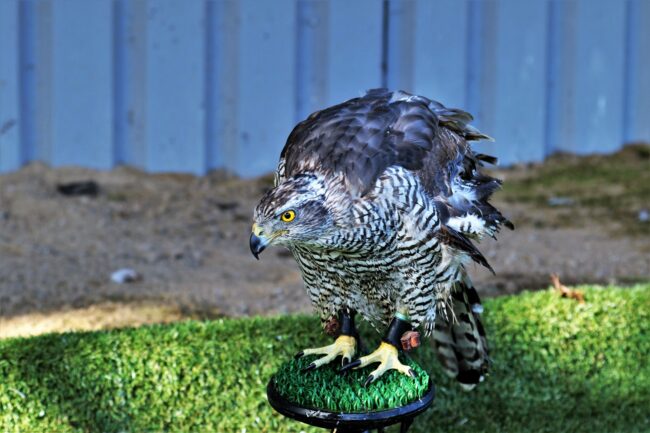
Macdonald starts out by talking about how hard it is to spot a true goshawk in the wild. People keep coming up to her to tell her about their sightings, but she doesn’t believe any of them and dismisses their insistence on the size of the animal as exaggeration and/or their memory playing tricks on them after the fact.
She goes on to describe goshawks as huge and larger then life, but they’re only about 24 inches, and at a later point in the book, she describes a scene in which her bird is perched a safe distance from, but in the same room as other birds that dwarf her, including an eagle and a vulture.
Macdonald’s fascination with birds is almost as entertaining as the birds themselves. Anyone who tries to sleep with their arms bent back like wings has an impressive level of dedication that I just can’t match.
Macdonald had trained falcons, but had always been told that hawks were particularly challenging, given their fickle nature, and their tendency to fly off and refuse to return to their trainer until they found a reason to do so. The warnings were sufficient to discourage her from hawk training until her dad died, and then she needed a challenge, so she decided to get herself a hawk.
She ordered a hawk from overseas and met the guy on the side of the road to pick up the bird. He had two hawks, one for Macdonald and another for a different customer. He started by pulling out the hawk for his other customer and Macdonald instantly fell in love. When he handed her the other hawk, she asked if she could have the first hawk instead, fully aware of how bizarre the request sounded, but it worked. The guy shrugged it off and handed her the first hawk and she and the hawk got to live happily ever after … more or less.
I loved a lot about this book because I have a husky and huskies are also known for being fickle and running off at every chance. When I first met my husky I had no intention of getting any dog at all, but she immediately climbed in my lap and licked my face and that was that. I tell people she adopted me and I had no say in the matter, and while she’s certainly challenging at times, overall we’re very well matched and I have no regrets. As I write this, I just heaved a big sigh, and then she immediately heaved a big sigh of her own. If that’s not a sign of our synchronicity, I don’t know what is. All this is to say that when Macdonald fell in love with her hawk and then was handed a different hawk, I fully supported her in her attempt to switch hawks.
I’m sure everyone comes away from this book thinking they can train a hawk, but given my experience training a husky, I feel particularly well equipped for hawk training. Huskies also love to roam free, and if they get a chance to take off, there’s no guarantee they’ll come back when you call them. It depends on their training and the bond between you and the dog, but it also depends on what they feel like doing in that moment, and hawks are very much the same. Given my success at husky training (she’s only run off once), I’m pretty sure I have what it takes to train a hawk.
I liked the way Macdonald went back and forth from telling her own story with her hawk, to T.H. White’s story of trying (and failing) to train a goshawk. She prefaces T.H. White’s story by saying her heart breaks for what his goshawk had to endure, which is not a great selling point for animal lovers such as myself, but Macdonald focuses on White and his personal struggles and how they shaped him and influenced his failed attempts at caring for and training a goshawk. She has a lot of sympathy for him, and as a result, her reader can’t help but sympathize with him.
Towards the end of the book, Macdonald talks about The Sword in the Stone and The Once and Future King and how White inserted himself into the story as Merlin. I may have read The Sword in the Stone as a kid, but it was so long ago, I barely remember it. I mostly remember the animated Disney version, but even that’s pretty fuzzy in my memory. With the insight of this book, I’ll have to reread it and finally dive into The Once and Future King now that I know so much more about the author (and hawks).