
I had never heard of this book by Alice Elliott Dark until my book club elected to read it. I got the audiobook from my library, and while it is good, it’s also very long (20 hours), so consider yourself warned. I just barely managed to finish it before it went back to the library.
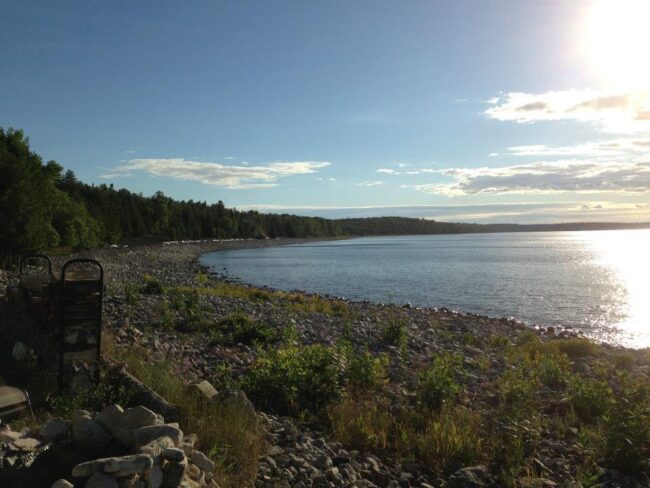
It’s hard to say what this book is about because it encompasses so much. The title comes from a fictional strip of land in Maine called Fellowship Point. The main character’s grandfather had bought the land in the 1800s with the idea of having something like Walden, where the land would be preserved, but only enjoyed by a privileged few families. He started it with his brother and some friends and they built 5 houses on the 35 acres of land. Initially the idea was to have a sort of commune so that all five families would own all five houses and they would use them interchangeably. But the men figured the women would want to decorate their own homes to their own tastes, so they decided each family would have their own permanent home on the Sank (short for Sanctuary). The houses are meant to be summer homes while the families spend the rest of the year in Philadelphia. And although the founder wants to live as simply as possible while on the Sank, no one can imagine getting by all summer without their servants, so the houses have to be large enough to house the families and their servants. No one seems to get the irony of it all.
The Fellowship is set up so that if they are ever to sell the Sank, 3 of the 5 families have to agree to the sale.
There are some flashbacks to the 1960s when the main character, Agnes, is a young woman, but most of it takes place in the early 2000s when Agnes is in her 80s. She never married and her siblings all died young, so she’s on her own. In addition to inheriting her family’s wealth, she became a very successful author, but somehow managed to do so without doing any promotion at all. She never gives interviews or makes appearances. She has an apartment in Philadelphia, but when her parents died, she decided to live on Fellowship Point year round.
At the time the book starts, an editor in Manhattan, named Maude, is trying to get Agnes to write her memoir. Agnes has always lived very privately and has no intention of revealing her secrets, but Maude is not to be dissuaded.
Agnes’s relationship to her BFF, Polly, is also pretty central to the book. Polly owns another one of the houses on the Sank. Although she married and had kids, the Fellowship was set up so that her husband could not own the house on the Sank. It could only go straight from Polly’s parents to Polly to her oldest son, who wants to sell Fellowship Point.
Polly and Agnes are trying to figure out how to save the Sank from being sold to developers. They talk to some preservationists, but Agnes is very picky about the people she likes and won’t hand the land over to anyone who doesn’t meet her high standards.
But time is running out and Agnes and Polly don’t have enough votes on their own to prevent the land from being sold.
Another drama that’s central to the book is that of Virgil and his daughter, Nan. They moved to the Sank in the early 1960s, but only lived there for a year or two before Virgil died and Nan was sent to live with relatives. Agnes had fallen in love with Nan and cared for her while Virgil worked on his writing, and had fought to take custody of her after Virgil died. But the court sided with the family members, and after a year or two, Nan died as well.
Shortly after that, Polly got pregnant and finally gave birth to a girl after having had a bunch of boys. But the girl only lived to be 9 years old before getting sick and dying.
The books that made Agnes famous are a series of books called the When Nan series. They’re children’s books about a nine-year-old girl named Nan exploring a part of the world that looks very much like Fellowship Point. Agnes’s theory is that nine-year-old girls are perfect beings, which just goes to show how little contact the author has had with nine-year-old girls.
I won’t spoil the ending except to say it seemed awfully contrived. That said, I did find the writing of this book beautiful, and I enjoyed reading about Agnes and her strong opinions. It’s also a nice change to read about older women and their friendships lasting a lifetime (which is not to say they don’t have their ups and downs). But I also found these characters to be quite elitist. They have this beautiful sanctuary, and while they talk about preserving the land as a noble pursuit, they only seem interested in preserving the land for themselves.
They also look down on a woman who married one of the other property owners of Fellowship Point because she wasn’t raised in the same world and doesn’t know the rules. All I could think of was how lonely that woman must have felt with everyone else on the property shutting her out.