
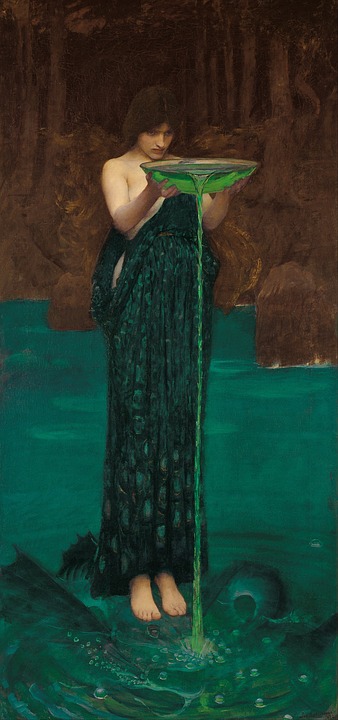
I’ve been meaning to read this book by Madeline Miller for more than a year now and I finally got my chance last month when I was waiting for my hold on The Nickel Boys to come in. It’s not super long, but it’s fascinating and the audiobook narrator does a fantastic job. I could listen to her narrate the phone book.
I had heard Miller on a podcast talking about this book, and the host of the podcast said it was the best book she read last year. I loved hearing Miller talk about how she wanted a female perspective on Circe and her life both with and without Odysseus. She knows how Circe got to the island, how she’s first described in The Odyssey, and she thought Circe deserved her own book. How true.
Miller also mentioned on the podcast that Circe only appears in 1/10 of The Odyssey, so she made sure Odysseus only showed up in 1/10 of her book. Now I’m going to start spoiling everything in this book, so consider yourself warned.
Circe ends up having a son by Odysseus, but doesn’t tell him she’s pregnant before he leaves, which is why we never hear about it in The Odyssey. At one point, her son, Telegonus, tells her that all she talks about is “Gods and fear, gods and fear,” and that’s pretty accurate. Gods and fear are both major themes throughout this book and that could have easily been the title.
Circe is the daughter of Perse, a sea nymph, and Helios, the sun god who is also a Titan, so Zeus is afraid of him because he knows Helios is more powerful than he is, but Helios fought for Zeus in the war against the Titans, so Zeus can’t exactly punish him. See? Gods and fear.
There’s a scene early on in the book where Helios lights a pile of wood on fire without touching it and informs his daughter, “That is the least of my power.” Circe tries and tries to do the same, but is unable to, so the power dynamic there is made clear right away.
What Circe is able to do is pharmakeia, a.k.a. witchcraft, but she doesn’t even know that’s what she’s doing at first. She just gathers some flowers she had been told had the power of Kronos and used them to turn a human she fancied into a god. When he chose another nymph over her, she used the flowers to turn that nymph into the monster who eats sailors who sail too close to her cave in their attempt to avoid getting sucked into Charybdis’s whirlpool.
Circe had been told that the flowers would bring out a person’s true nature, and she thinks that’s all she’s done, without thinking it odd that their “true natures” just happened to be exactly what she wanted them to be.
Circe admits to what she’s done, but no one believes her. Her family is shallow and cruel and constantly ignoring and underestimating her. Once she comes forward, though, her brother and only friend, admits that it’s true and that he and their other two siblings all have the same powers. He gives a demonstration of his powers and Helios has to go talk to Zeus about what to do with them. They decide not to do anything to Circe’s siblings, but Circe is to be banished to a deserted island. I can’t actually remember what the justification for that was. Something to do with Circe’s siblings not being able to do any harm where they were, but I can’t remember why they considered Circe a threat. Her brother said the truth was because she flaunted her witchcraft when she should have downplayed it or kept it hidden.
So Circe is left to live out the rest of her immortal days in exile, but if she were to just sit there until Odysseus showed up, it would be supremely boring. Of course gods drop in as they please because technically, she has been prohibited from leaving the island, but they have not been prohibited from visiting her.
Hermes likes to visit from time to time, he gives her updates and they sleep together. When he’s not around, Circe collects herbs and perfects her witchcraft.
She goes on to have all kinds of adventures, and the reason she turns all men into pigs is because the first sailors to arrive on her shore and take advantage of her hospitality raped her, so she no longer takes any chances.
I was thinking about how odd this is. I know mortal men raping nymphs is very common in Greek mythology, but if they’re immortal, wouldn’t they be much stronger than mortal men and therefore able to fight them off? It makes me think the myths were written by men who assumed women are always weaker than men, and men always have a right to women’s bodies, even when those women are powerful, immortal beings who can turn men into pigs with a few herbs and a word.
What did you read/listen to this week? Any other new takes on old classics?