
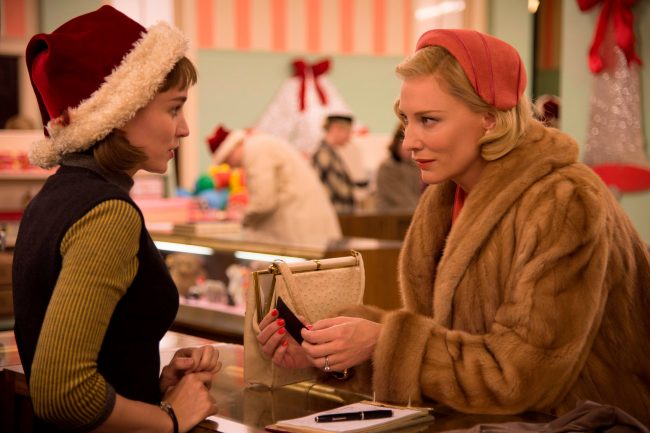
I wanted to see “Carol” when it came out a few years ago, mostly because it has an excellent cast and because of the few Oscar nominations it got. But being me, I wanted to read the book first, so I grabbed a copy when I was in an indie bookstore with my dad a year or two ago.
Then BookRiot challenged me to read an LGBTQ+ romance and that was my excuse to rush Patricia Highsmith’s book to the top of my reading list.
Considering how excited I was for it, I’m not sure how I feel about this book. I liked it, but I didn’t love it as much as I was expecting.
Mostly, I didn’t buy into the romance. The main character, Therese, is working as a salesgirl in a department store (around 1950) in the doll department for the Christmas rush. A beautiful, glamorous woman in a fur coat buys a doll and gives Therese her address so it can be delivered, making sure it will arrive before Christmas.
Therese is immediately smitten and that’s really where Highsmith lost me. How can you love someone you haven’t exchanged three sentences with? It didn’t strike me as love so much as obsession. I’ve never bought into the idea of love at first sight, but I think you kind of have to in order to buy into the romance Highsmith is selling here.
Anyway, since she has Carol’s address, Therese decides to be a little stalkery and send Carol a Christmas card. Instead of calling the cops (as a modern woman would be more inclined to do, especially if Therese had been a man), Carol invites Therese out for drinks.
Turns out Carol is married with a daughter, but she and her husband are in the process of going through a divorce and her daughter would rather spend Christmas with her dad. Carol is deeply depressed about it and invites Therese out to her house in New Jersey, I think as much to fight off her loneliness as because of her attraction to Therese. Pretty soon they’re regularly going out to lunch and parties together. Therese meets Carol’s friends and Carol meets Therese’s boyfriend, for whom she suddenly feels less than ever, which apparently isn’t saying much.
Still smitten, Therese doesn’t seem to say much when she’s with Carol. Carol unloads her woes on Therese, who mostly just seems happy to bask in Carol’s glamorous presence.
After a few months, Carol suggests she and Therese go on a road trip together. Therese would follow Carol to the ends of the earth and she doesn’t have much keeping her in New York, so she agrees and they set off.
Throughout it all, Carol is moody and often lashes out at Therese, who takes it without complaint. I’ll admit I would have viewed this completely differently if Carol had been a man, but as a woman, I was glad to see her as a flawed human, rather than some idealized version of a lover. Especially since she was going through a contentious divorce, which is never easy and made her moodiness understandable.
Despite not being a fan of the romance itself, I loved Highsmith’s writing. It was gorgeous and I found myself seduced by it as Therese and Carol seduced each other.
The book has garnered a lot of praise for being one of the first to give its LGBTQ+ characters a happy ending, but that’s not to say they don’t make sacrifices for each other. Carol loses custody of her child as a direct result of her relationship with Therese and is allowed to see her daughter only very rarely and only if she refuses to never see Therese again.
Initially, Carol agrees, breaking Therese’s heart in the process, but then she decides to say, “screw it,” gets a job and her own apartment in the city, and invites Therese to move in with her. She explains that with so little access to her daughter, her ex-husband will probably end up using his custody to turn her against Carol, who will end up losing her daughter along with Therese.
Her ex-husband holds all the cards, but Carol refuses to be manipulated and I kind of loved that about her. It was a huge sacrifice, but I found her explanation to be, not only in line with her character, but done in such a way that I found it to be believable and understandable, without condemning her as a mother.
Using a child as bait in a divorce is despicable, but it’s also usually fairly effective because most people will do anything for their children. Carol is no different from most parents, but she realizes she’s already lost. It’s out of her hands, and to sacrifice what she has with Therese would be to give up the one thing she has left for a man she’s no longer married to, and she’s not likely to gain anything substantial in exchange for the sacrifice.
Therese is still stinging from the breakup, so she initially refuses, but then changes her mind and heads off to Carol’s apartment, presumably to live happily ever after with her.
What did you guys read this week? Any other classics that have recently been made into films?