
I read The Devil in the White City as soon as I heard Leonardo DiCaprio had bought the film rights (still waiting on that Leo…). I loved it, so when Erik Larson came out with this book a couple years ago I couldn’t wait to read it.
Of course, with my massive TBR list, this one kept getting pushed back. Probably because it’s nonfiction.
But lately I’ve been listening to more and more audiobooks, especially nonfiction, and finally I realized I didn’t have to make time to read Larson’s latest book. I just had to make time to listen to it.
Hurray for audiobooks!
It was totally worth the wait, though. I had forgotten what a phenomenal writer Larson is, but this book lost no time in reminding me.
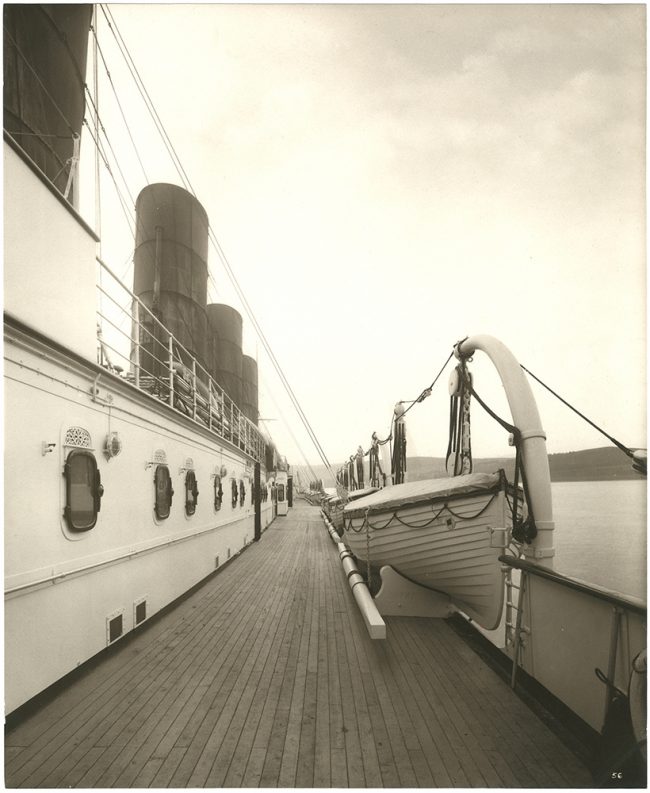
Dead Wake is about the sinking of a British passenger steamship called the RMS Lusitania just off the English coast in the spring of 1915. They were in the “battle zone” so to speak, meaning they knew it was likely there would be German submarines in the area. Although the possibility of being torpedoed was known and talked about among the crew and passengers, no one could have foreseen the amount of destruction one torpedo could wreak (for a long time, it was believed there were two torpedoes because many witnesses reported two explosions, but there was, in fact, only one).
Larson wrote about the event from several points of view: the German U-boat commander who sunk the Lusitania, a top secret room in London in charge of war intelligence, President Woodrow Wilson, and various passengers and crew members who were on board at the time the torpedo struck, including Captain Turner, who was captain of the ship at the time. Larson did an excellent job of telling the story mostly chronologically and giving each perspective for each section of the timeline.
Submarines were still fairly new and they had their limitations. They weren’t very fast, they could only stay underwater for so long before needing to resurface, they were horribly cramped and smelly, and the chances of dying a horrible death locked in a steel coffin underwater were uncomfortably high. I’ll never understand the kinds of people who volunteer for things like that when the technology is so new and untested.
Also torpedoes were slightly more likely to fail than they were to work properly (about 60/40 in favor of failure) assuming they hit their target. So the fact that U-boat 20 was able sink the Lusitania so spectacularly was a feat of pure luck on their part (and very bad luck on the part of everyone on board).
I don’t know what Germany was thinking. They must have suffered from an exceptional case of overconfidence to torpedo ships they knew contained American civilians.
In the months leading up to the Lusitania’s final voyage, Germany had bombed merchant ships containing American civilians and even published a warning in the New York Times on the morning of the Lusitania’s final departure from New York that all ships (neutral as well as enemy) in the “battle zone” (my words, not theirs or Larson’s) would be subject to torpedo. Many passengers ignored the warning and others simply didn’t have time to read the paper that morning. A few did decide to stay behind.
While many on board were nervous of the possibility of being torpedoed, most of them felt safe in the assurance that the British navy would escort them to port once they reached British waters. This was an assumption on their part because the British navy never actually said they would provide an escort.
Larson worked hard to remain neutral and stick with just the facts, which is why he stopped just short of coming right out and saing the British had conspired to let the Lusitania be sunk.
They couldn’t have known exactly what was going to happen, but they knew U-boat 20 was in the area and had been known to sink merchant ships. They took great pains to protect one of their giant navy ships that was in the area at the time, but provided no such measures for the Lusitania.
Larson does provide quotes from other politicians at the time who investigated the matter and arrived at the conclusion that the British government deliberately allowed the Lusitania to be sunk because they knew many American passengers would be on board and they were hoping to draw America into the war on their side. In fact, various conversations and telegrams from within the British government certainly seem to point that direction.
Nevertheless, no one could have predicted just how awful the event would be. Everyone assumed that if the boat was torpedoed, there would be plenty of time to get all the passengers onto the lifeboats and to safety.
In fact the ship sunk in a mere 18 minutes, there weren’t enough lifeboats for everyone, except maybe if you counted the collapsible lifeboats – which no one had time to construct as the ship went down. In several cases, the rigging failed and passengers on lifeboats were plunged into the water or slammed against the side of the ship.
A few were sucked into the ship’s smokestacks as it sunk, but were then blown back out, covered in soot, but unharmed.
Life jackets were provided in passengers’ cabins instead of on deck, which seems completely inane. Also they were new life jackets, rather than the traditional cork life jackets, and few passengers had received instructions on how to wear the jackets properly. This meant that many who had put them on improperly ended up suspended upside down in the water, where the drowned.
More than a thousand people were killed and only a few hundred survived.
I was impressed with Larson’s ability to draw out the suspense leading up to the actual sinking of the ship, considering we all know how it ends. It’s a testament to his skill as a writer, as well as his dedication to showing that event from as many different perspectives as possible.
He also covered the aftermath of the war, including what happened to the bodies that could be found, Wilson’s decision to enter WWI, and how and when some of the more notable survivors eventually died. It was an event that either made or broke those on board.
I have absolutely no complaints about this book. It was phenomenal as an audiobook and I recommend it to everyone!
What did you guys read/listen to this week? Anything else that’s been on your TBR list for a while?