
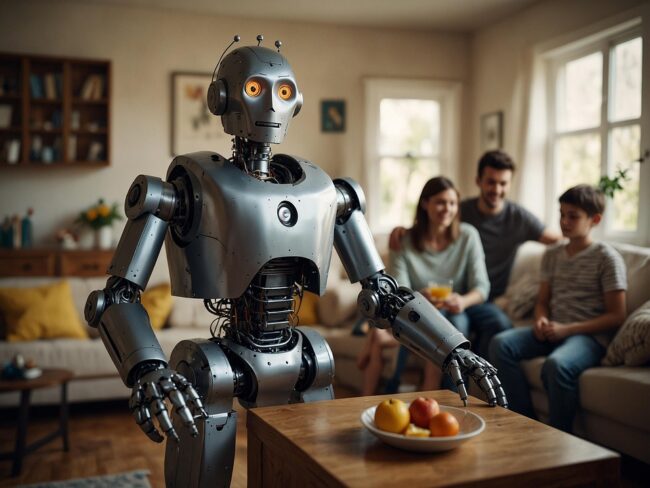
Imagine humans have programmed robots to do everything for us, including:
- Cook our meals
- Arrange our travel
- Clean our clothes
- Investigate and solve crimes
- Fight our wars
- Even fix other robots
But, when society breaks down and most of the humans die off, what becomes of all those robots who were literally made to serve?
That’s the question Uncharles faces for most of those book.
When we meet Uncharles, he goes by the name Charles and is employed by a man we can assume is of advanced years (I was thinking around 60, but I don’t think it’s ever said) and fairly well off.
Charles has a series of tasks he has to complete every day, many of which repeat at a certain time every day, including checking his master’s travel arrangements. His master hasn’t had any travel arrangements for more than two years, but he never bothered to tell Charles to permanently delete the task, so Charles still has to go through the motions of checking to make sure his master has no travel arrangements.
Then he has to ask the house (because I guess even the house is robotic?) to check the master’s travel itinerary with the mistress’ travel itinerary, even though the house hasn’t had a mistress for about two years. Again, it’s on Charles’s task list, which means it must be done, even as he recognizes the futility of the task.
The beginning of the end of Charles’s life comes as Charles realizes his master is dead, having had his throat slit. As he reviews his own footage to see what happened, Charles realized he himself slit his master’s throat while shaving him. He has no memory of doing so and no idea why he would do so.
After doing some bizarre things to try to rectify the situation, like taking his master out for some fresh air, as if that will revive him (to be fair, he’s not a medical bot), he finally calls the police to turn himself in.
A couple of robots show up to investigate, but they clearly have no idea what they’re doing. Charles tries multiple times to confess to the crime, but they refuse to take him at his word. They end up leaving the house and Charles is free to go.
But the name “Charles” doesn’t even belong to him. It belongs to the house and is to be held by the house until it can be assigned to a new “service model.”
Someone gives Charles the name “Uncharles” as a joke, and he ends up going with it.
Uncharles embarks on an adventure to find a new employer who could use a service model. He starts by going to get himself repaired, but quickly realizes the line isn’t moving, and to keep the line at a manageable length, robots are randomly being selected to be destroyed.
Uncharles meets another robot that introduces itself as The Wonk, and tries to tell Uncharles that killing his master was a symptom of the Protagonist Virus, which means he’s developing agency and starting to make his own choices.
The problem is Uncharles doesn’t want to make his own choices. He wants to be given a task list to complete.
He does find temporary employment with someone who is running what he calls a farm. The initial idea seems to have been for people to experience what it was like to live and work in an age before robots. In reality, the guy who runs the farm is a kind of dictator who makes everyone else work while he lives like a king.
Uncharles isn’t supposed to have feelings or preferences, but he definitely doesn’t like this guy. He finds himself testing the boundaries of his services. For example, when he’s told to make the guy a sandwich, he makes it, then realizes he was never told to serve him the sandwich. So he makes it and then just stares at it for a while until The Wonk appears and they have a short conversation.
Afterwards, the presence of The Wonk is discovered by the dictator who is not happy. They appear to have some sort of a history, although we never learn what that history is.
Uncharles and The Wonk end up escaping together and heading out to find employment for Uncharles.
It quickly becomes apparent to the reader (not to Uncharles) that The Wonk is not a robot, but a young woman. She keeps turning up in Uncharles’s adventures as they travel to the library, which is supposed to be the source of all information, but due to their record keeping system and the fact that everything is 0s and 1s, everything has been broken down to the most basic level and organized numerically, which leaves a string of 0s followed by a string of 1s.
So they skedaddle out of there, then Uncharles finds himself in the middle of a war between two factions of robots who seem to be fighting only because they were built to fight. Just like Uncharles doesn’t know what to do without a master to serve and a task list to complete, they don’t know what to do without someone to fight.
Uncharles finds his way out of there, and eventually he and The Wonk make their way to the source of a voice that has been in Uncharles’s head, presumably helping him in his journey to find work. The problem is he keeps directing Uncharles either to robots or to humans who have no use of a top-of-the-line service model.
Uncharles ends up calling the voice God, although it never confirms or denies being God. So when they get to God’s waiting room and find other robots there waiting — apparently indefinitely — the comparisons to Waiting for Godot wrote themselves.
This book hooked me quickly. It’s quirky and delightful and I was immediately intrigued by the world Adrian Tchaikovsky was building. The humor is reminiscent of The Hitchhiker’s Guide to the Galaxy, so if that’s your thing, you’ll enjoy this book.