
I read this book for a Bonnets at Dawn readalong, and while George Eliot is normally one of my favorite writers, I didn’t really like this one.
The main character, Silas Marner, is a weaver in the English countryside before the industrial revolution makes his job obsolete. His life is upended and his faith shattered when his best friend frames him for theft and steals his fiancée.
Since the church fails to vindicate Silas, he loses his faith in the church as well as his faith in humanity. He moves to another town where he lives as a hermit. People still hire him because there isn’t another weaver around, but unflattering rumors surround him, and he lives apart from the community. All he does is weave and count his gold. He lives frugally, so he doesn’t have much need for gold, but it becomes an end in itself.
Meanwhile the local squire’s two older sons, Godfrey and Dunsey, are arguing over some money Godfrey loaned to Dunsey that Dunsey has no intention of paying back. The money was rent from one of their dad’s tenants and their dad is starting to demand the money, which is making Godfrey anxious.
Dunsey is never anxious about anything because he’s a spoiled rich boy and things always work out for him. He is a lazy drunk and a gambler.
When Grodfrey threatens to tell their dad that Dunsey took the money, Dunsey threatens to tell him that Godfrey is secretly married with a two-year-old child. Godfrey can’t have that come out because if it does, their father will disown them both. Dunsey is willing to roll the dice because he’s confident in the aforementioned fact that everything always works out for him.
Also Godfrey still has the hots for a local woman named Nancy Lammeter. She’s not gentry, but her family has much more money and a higher standing in the local society than Godfrey’s wife, Molly.
Rather than pay Godfrey back the money, Dunsey persuades Godfrey to let him sell his prized horse for him so he can use the money to pay the rent his dad is waiting for. Godfrey agrees because he’s backed into a corner.
Dunsey sells the horse, but decides to ride the horse in a hunt before delivering it to the buyer. Of course he’s drinking and driving and ends up killing the horse. Rather than own up to it, he walks home and happens across Silas’s cottage. Silas’s pile of gold is no secret. Everyone knows about it and Dunsey wonders that he hadn’t thought of convincing or threatening the old man into giving them his gold so they can pay their debts.
He walks in with the intention of doing so, but Silas is out on an errand, having left his door unlocked because it’s that kind of town. Rather than wait for him, Dunsey convinces himself that Silas is probably dead and therefore has no need of the gold, which has been hidden under a floorboard. Dunsey finds it and runs away, begging the question why he should bother to hurry away if Silas is dead.
Of course Silas is not dead and returns home to find his gold missing. He accuses one of the townsfolk who happens to have an alibi. The townsfolk all help him look for the gold and clues as to who might have stolen it. They decide it was probably that traveling peddler who passed through a while back. Of course no one suspects the squire or his family, despite the fact that Dunsey is never seen again. No one seems worried about the fact they haven’t seen Dunsey in a while because it’s not unusual for him to disappear for a few weeks of gambling and carousing, only to turn up again when he needs to dry out.
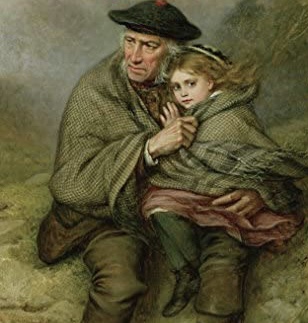
Silas is distraught without his gold, and he sits at home, alone, waiting for it to magically return to him. His eyesight is not great, so when a blonde two-year-old girl finds her way into his cottage on New Year’s Eve, he at first sees only the golden curls and assumes it is his gold returned to him.
Once he realizes what really happened, he follows the child’s footprints to the body of her mother. Turns out Godfrey’s wife had been on her way to the party at the big house to reveal herself and her child to the squire and make a big scene. But she’s addicted to laudanum and couldn’t resist taking some on the way to the house. It made her so sleepy she fell asleep in a pile of snow and either overdosed or froze to death. Fortunately for her child, they were near Silas’s cottage, and the child was attracted by the light streaming out of Silas’s open door.
Silas crashes the party to tell everyone what happened and the doctor is rushed out to see if anything can be done for the woman. No one knows who she is except for Godfrey and he certainly isn’t going to step forward because, with her and Dunsey gone, and the child taken care of, all his problems are solved. He’s free to marry Nancy, and he does so.
Silas falls in love with the child almost immediately. He says she came to him and he has a right to keep her. Dunsey had no qualms about this, telling himself he’ll make sure the child is provided for and he does donate money and furniture to Silas to help support him and Eppie, as Silas ends up naming the child.
Having adopted a child, the neighborhood suddenly sees Silas in a whole new light and they come together to support him in his determination to take care of her. They offer food and clothing and child rearing advice.
Silas becomes convinced his gold was returned to him in the form of Eppie and he’s more than willing to accept this trade off.
I won’t give away the ending because it’s pretty juicy. I’ll just say that this book didn’t have as much of the gorgeous prose as I’ve come to expect from Eliot. As compelling as her characters are, I just didn’t find the story interesting.